Birder’s Notebook

Photo by Kate Persons
Long ago, before sea level rise and then politics intervened, man and other animals moved freely through the Bering Strait region between Asia and North America. Today there are still a handful of...
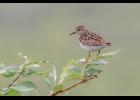
Photo by Kate Persons
Least sandpipers might be tiny, but they are spunky, spirited sprites worth getting to know. Barely larger than a sparrow and weighing only about an ounce, the least is North America’s smallest...
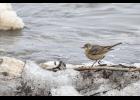
Photo by Kate Persons
*/ American pipits are delicate-looking songbirds that defy their appearance to buck strong winds and endure the harsh condition of their alpine breeding grounds. This slender, fairy-like bird...
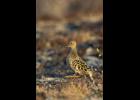
Photo by Kate Persons
Every spring during migration, I keep a sharp eye out for a special shorebird–the elegant and charismatic buff-breasted sandpiper. In many years “buffys” are not even reported in the region, and...
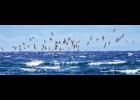
BOUND FOR WRANGEL ISLAND – A flock of dazzling white snow geese with black-tipped wings takes off from Safety Sound after a brief layover for food and rest en route to their breeding grounds on Wrangel Island, Russia.
Sometimes spring migration begins with a tantalizing trickle of birds, and sometimes there is an overwhelming but welcome deluge. This year the flood gates opened in mid-May. Among the many species...
MALE SPRUCE GROUSE – A male spruce grouse walks over the snow in late spring. Spruce grouse spend the winter feeding in the upper branches of spruce trees. As spring comes, they spend more time foraging on the ground. They seldom fly unless flushed into a nearby tree, or when males perform short courtship displays.
The Seward Peninsula’s spruce forests are home to another well-adapted winter resident, the aptly named spruce grouse. These handsome and hardy grouse are found throughout the boreal and montane...
CANADA JAY AT A CACHE – A Canada jay is fluffed up on a winter day, eating meat it previously cached in the fork of a branch. Canada jays spend summer and fall gathering and storing thousands of bits of food, and use their sticky saliva to glue it to hiding places under bark, beneath lichens, or in forked branches. They scatter their secret stashes throughout their territory in preparation for winter scarcity, and remember where to find them.
With temperatures hovering around 30 below zero over the snowy, windswept landscape, early January seemed an uninviting time to be a bird in Nome.  While the winter scene appeared devoid of food or...
MOURNING DOVE – A long-lost mourning dove perches in a shelter built for it after it arrived in Chuck and Peggy Fagerstom’s backyard in Nome in the aftermath of ex-typhoon Halong. The Fagerstroms are enjoying the stranded dove’s company and are providing it with shelter, water and a generous buffet of bird seed to see it through the winter, far north of its normal range. The mourning dove is a first for Nome’s Christmas count.
Thanks to clear, calm weather, an abundance of volunteers and sightings of most of our expected winter bird species, Nome’s 50th Christmas Bird Count was a success. Count day began with a stunning...
GYRFALCON—A gyrfalcon is perched with its back to the sun, soaking up warmth from the first rays that hit the cliff where it roosted on a 0°F night. These large, arctic falcons are year-round residents in the Nome area. They are well insulated by dense feathers that extend down their upper legs and drape down to insulate much of their lower legs as well.  Like ravens, a gyrfalcons’ large body size relative to its surface area helps prevent heat loss during periods of inactivity.
Recently, it was -12°F at Banner Creek in the dim light of late morning. Out the window, three chickadees flitted and bounced energetically through the willows, eating and caching seeds from our...
BABY FOOD – A male American three-toed woodpecker is bringing a billful of insect larvae to his nestlings. The young were in a nest cavity that he and his mate had excavated in the fence post on which he is perched, which was next to a busy parking lot in Fairbanks. Although three-toed woodpeckers can be frustratingly hard to find, they also can be very tolerant of people and allow close observation.
Many Nomeites are familiar with the small black-and-white, forest-dwelling downy woodpeckers that sometimes show up in the willows around Nome in winter. Some are here now. But fewer people know of...

Pages

The Nome Nugget

PO Box 610
Nome, Alaska 99762
USA

Phone: (907) 443-5235
Fax: (907) 443-5112

www.nomenugget.net

External Links