

Buff-breasted Sandpiper––an elegant visitor delights observers
Every spring during migration, I keep a sharp eye out for a special shorebird–the elegant and charismatic buff-breasted sandpiper.
In many years “buffys” are not even reported in the region, and sightings are usually of only one or two birds. So it seemed like a buffy bonanza this spring when over 20 of these beautiful sandpipers were reported on eBird after sightings between Safety Sound and the tundra ridges west of Nome.
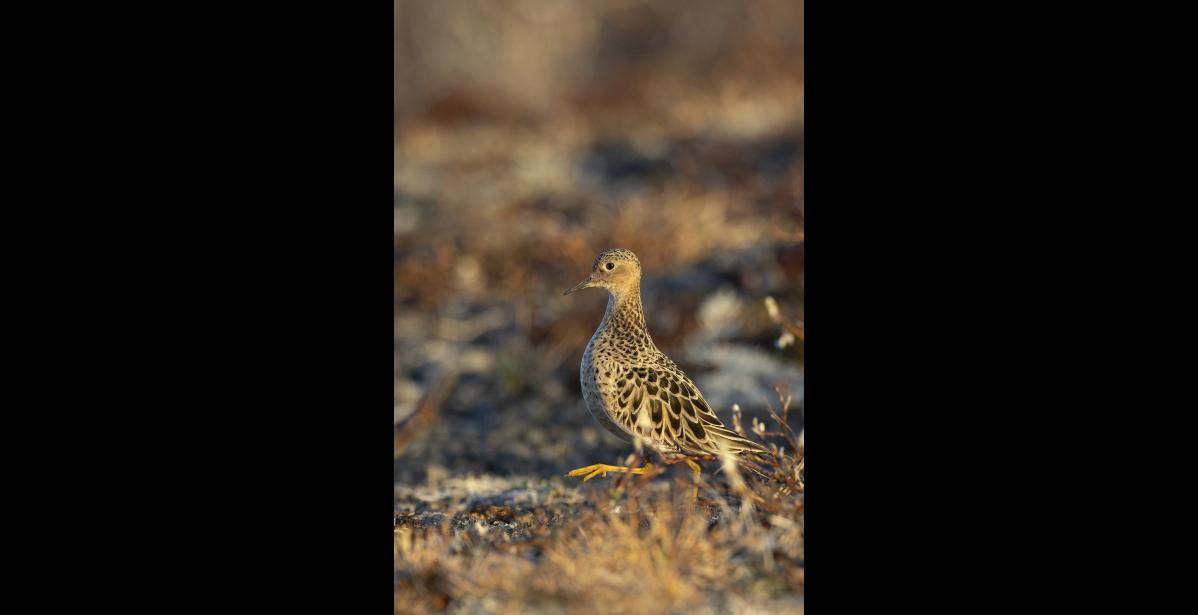
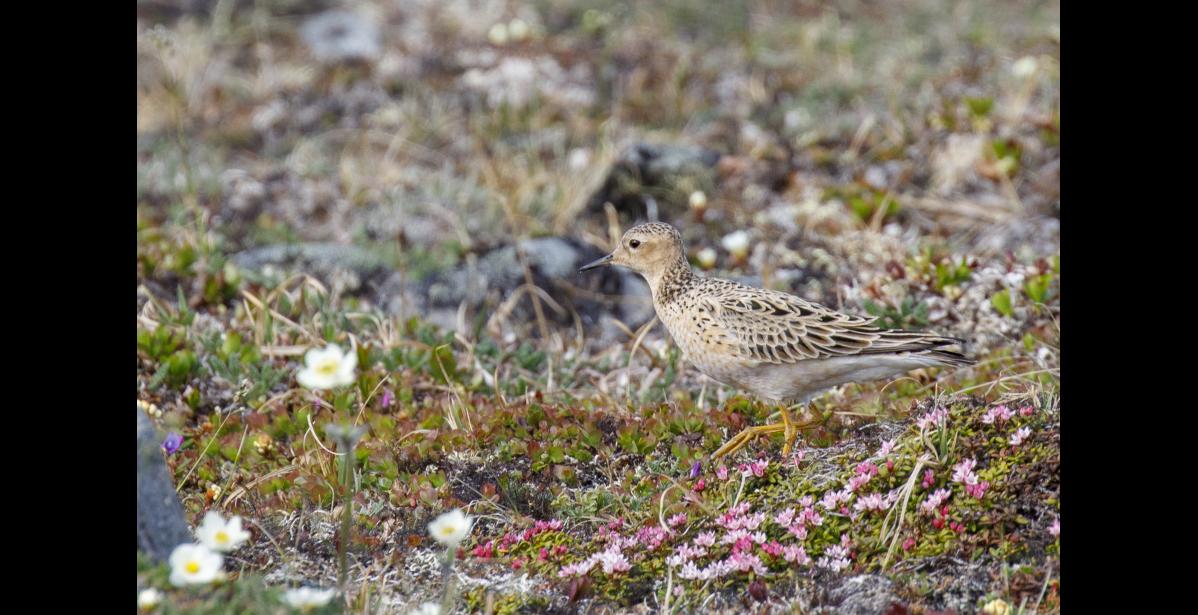
The buff-breasted sandpiper is a beauty. This delicate, medium-sized shorebird has a distinctive warm and creamy, yellowish-tan coloration on its head, neck and breast with a rich, dark scaly pattern on its back, and vibrant yellow legs. A rounded head and large dark eyes give this lovely bird a gentle, dove-like look. Their bright, white underwings flash prominently in flight and during their dramatic courtship displays.
Buffys are long-distance migrants. Most buff-breasted sandpipers breed on the arctic tundra of Canada and Alaska, east of Utqiaġvik. Their extensive travels take them through central North America to wintering areas in the grasslands and agricultural areas of southeastern South America.
What are buffys doing here, so far from their regular route and destinations?
I found no reports of buff-breasted sandpipers nesting on the Seward Peninsula. But a 1978 account of a small group at Cape Woolley “courting and copulating into early summer” makes it seem possible that it may occasionally happen.
An unknown number of buffys have long been said to nest locally along the arctic coast of Chukotka in northeastern Russia, and on Wrangel Island. Also, they are occasionally seen during fall migration along the Pacific Coast of North America.
In her 1989 publication Birds of the Seward Peninsula, Alaska, ornithologist Brina Kessel suggested that the occasional migrants seen in this region and along the Pacific coast are part of a distinct population of buff-breasted sandpipers that breeds in the Russian far east and migrates along the Pacific coast, rather than through mid-North America.
There have been no banding, tagging, anatomical, or genetic studies to investigate differences between possible western and eastern populations.
During migration, buffys often travel singly, in pairs or in small flocks. When I have had the delightful surprise of encountering these intriguing visitors, they have been busily foraging in dry, rocky, upland tundra. They can be quite tolerant and often will allow observation from a respectful distance.
In the style of a plover, they walk quickly through tundra habitat, stopping often and abruptly to look and listen, snatching prey from the ground or vegetation. Their bills are short, and unlike many other sandpipers, they don’t probe for food.
Buff-breasted sandpipers eat mainly insects, spiders, snails and sometimes seeds. Their diet on the breeding grounds differs from that of most arctic shorebirds because they inhabit dry tundra habitats rather than wetlands. Thus, they depend largely on adult and larval insects such as beetles and flies, especially crane flies, rather than the wetland invertebrates eaten by most breeding shorebirds.
In addition to their distinctive good looks, buff-breasted sandpipers have an interesting and unusual system for mate selection—the males form “leks.” This is a common behavior for grouse, in which males gather closely together and display, each attempting to outdo the others, to woo mates.
Buffys are the only shorebird in North America to form leks and one of only three shorebird species worldwide to do so.
When males reach their breeding area, they form what is called an “exploded lek.” They spread out over a large area, but within sight of each other. Each male establishes a small territory where he performs energetic displays to catch the eye of females.
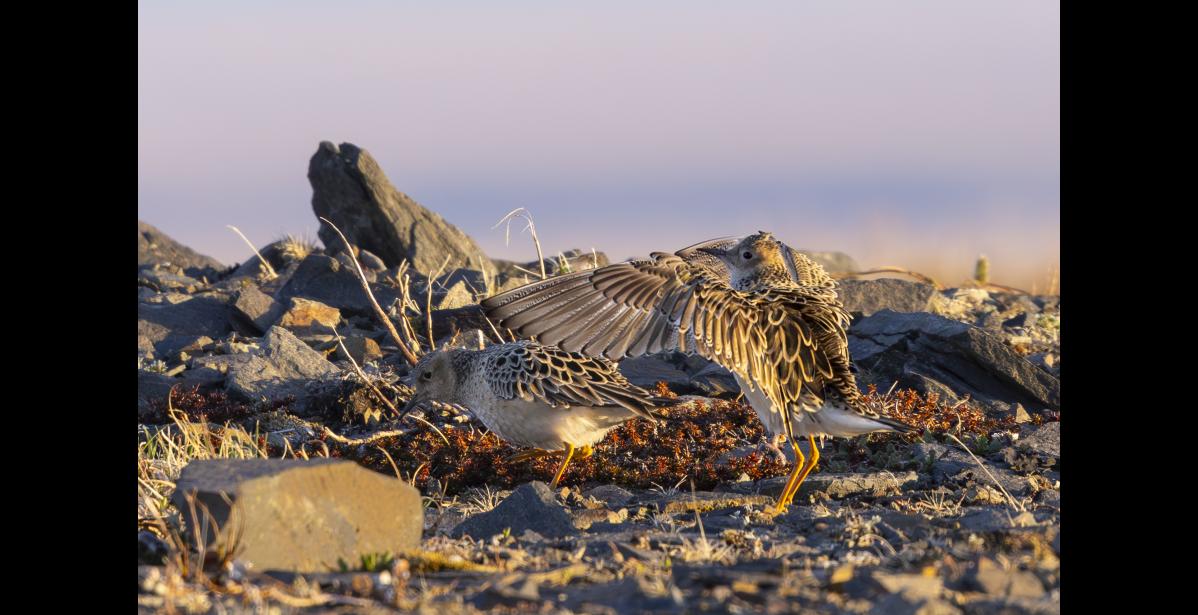
The leks last several days, and it is a lively and sometimes chaotic affair. Displays include up to 17 different postures or movements. One often-used and alluring display is the wing wave. A crouched male lifts his tail and raises one wing to the sky, waving it slowly, causing the bright-white underwing to flash like a beacon above the tundra grasses–an unforgettable sight I savored over 50 years ago on the tundra near Utqiaġvik.
Males may leap into the air on fluttering wings or raise and open their wings towards a receptive female as if to offer a hug. With bill pointed skyward, males puff up their chests impressively, rise onto tiptoes and move forward with mechanical up-and-down wing movements.
Males may try to disrupt the displays of other males and even mimic female behavior, resulting in attempts by males to mate with other males at the lek.
Some of the displays are not just reserved for the breeding grounds. They may be performed in winter and during migration, even by solitary birds. It is possible to see parts of the show here, if you are lucky enough to observe buffys when they pass through.
Males may mate with more than one female, but unlike grouse and some other lekking species in which only a few dominant males breed, most male buff-breasted sandpipers have opportunities to mate.
Males and females do not form pair bonds, and males play no parenting role. After mating, the female leaves the lek to nest and raise the young alone, elsewhere.
Buff-breasted sandpipers were once abundant, but the species is now very uncommon. The largest declines occurred in the late 1800s and early 1900s when many were shot by market hunters during migration.
After market hunting was curtailed, declines continued. More than 50 percent of the buff-breasted sandpiper population has been lost in the last 50 years, and declines have accelerated in recent decades. Destruction and degradation of the grassland habitats they depend upon in their wintering areas and during migration is considered a major factor.
Despite the discouraging decline of this fascinating sandpiper, a number of us were thrilled to see small flocks and individuals passing through this spring—more buffys than I have seen since my youthful days in Utqiaġvik.
You just never know what delights you will find until you go out looking!