
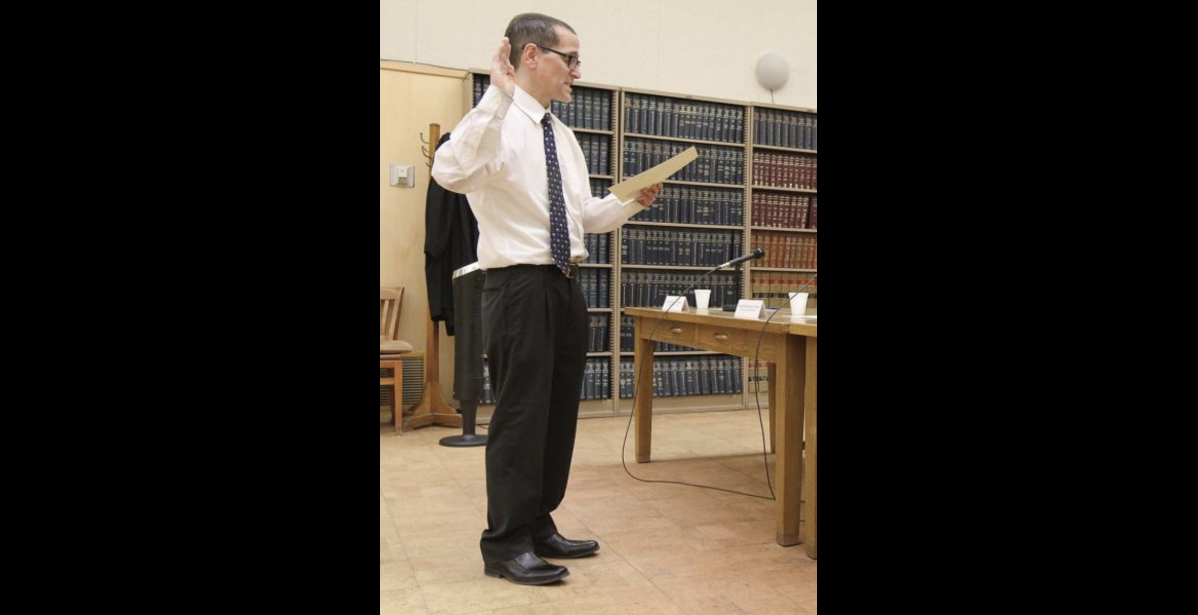
Commission recommends former judge DiBenedetto to be removed from office
Former Nome Superior Court Judge Romano DiBenedetto faces stiff punishment in form of removal from office and the prospect to never return to the bench as a judge in Alaska, following a meeting of the Alaska Commisson on Judicial Conduct in which the panel voted on disciplining DiBenedetto for behavior that ran afoul of judicial canons and beyond.
The complaints stretch over several years. The first tranche of complaints centered on DiBenedetto delaying court proceedings because he preferred to watch a televised sports event and lied about his tardiness.
In another complaint, in presence of court staff, he imitated or “reenacted” testimony that occurred in court and mocked “persons who are part of ethnic groups other than his own.”
DiBenedetto was put on administrative leave for nearly a year, while collecting his full salary, before he resigned from his post in April 2026.
In July 2025, the Alaska Commission on Judicial Conduct recommended to the Alaska Supreme Court a public reprimand, the least severe of consequences but as more information surfaced, the panel asked the Supreme Court to not act on its recommendation until more is known.
More complaints surfaced and an amended complaint broadened the picture of the judge’s behavior off the bench. The commission was made aware of a criminal investigation by the Alaska Bureau of Investigations, in which the judge’s phone number peripherally appeared.
DiBenedetto was not the subject of the investigations into a sex ring and trafficking, but records found his phone number calling online commercial sex advertisements. This does not constitute criminal conduct, but the commission found that “in the context of Mr. DiBenedetto’s position as a sitting superior court judge, the contacts created a serious appearance of impropriety, materially undermined public confidence in the integrity and impartiality of the judiciary and gave reasonable members of the public substantial grounds to doubt Mr. DiBenedetto’s judgment, integrity, impartiality and fitness to serve as a judicial officer.”
In addition, DiBenedetto’s Facebook account, in which he was identified as a judge, showed “apparent associations with adult-oriented, sexually suggestive and commercial sex-related content.”
When asked about it, he denied know about the existence of the “problematic material” on his Facebook page, assured to address the concerns but did not act on them until he closed his Facebook account and deleted the record of its contents in May 2026.
In Tuesday’s public meeting, held via Zoom, the Alaska Judicial Conduct Commission’s Chair Amy Mead read through the complaints and said that DiBenedetto acknowledged his conduct as bringing the judicial office into disrepute and in violation of the code of judicial conduct. She said he accepted the commission’s recommendation to be removed from office and voluntarily waived his right to a formal disciplinary hearing. “He recognized that the conduct did more than reflect poorly on him personally; that it undermined public confidence in the judiciary and in the court's ability to serve the people of the Second Judicial District fairly, impartially, or with sound judgment,” she said. “The public is entitled to expect more from a judge. Mr. Benedetto recognized the practical consequences for Nome and the surrounding region.
“As a result of his conduct and the proceedings that followed, the community went without a resident superior court judge for a substantial period, placing added burdens on litigants, attorneys, court staff, visiting judges, and the community served by the Nome court. This absence disrupted the regular administration of justice in a district where dependable access to the court is especially important,” she said.
Removal from office can be recommended even when the judge has already resigned from the bench. The commission does not have the authority to make any recommendations to the Supreme Court with respect to the license to practice law.
Commissioner Aldean Kilbourn of Fairbanks made a motion that the commission recommend to the Alaska Supreme Court that former Judge DiBenedetto be removed from office. “This motion is being made despite Mr. DiBenedetto's retirement, in order to protect the integrity of the Alaska judiciary, ensure accountability and deterrence, and prevent Mr. DiBenedetto's return to the bench in Alaska as a pro tem or senior judge,” Kilbourn said.
The commission members passed this and an identical motion to remove DiBenedetto, in response to the 2025 case, dealing with tardiness to court proceedings and mocking of testimony.
DiBenedetto was appointed to the judgeship in Nome in 2017, following predecessor Tim Dooley who also earned censure from the Alaska Supreme Court for inappropriate remarks from the bench that showed cultural bias and eroded the confidence in the judiciary.
In a letter to the commission last year, Kawerak CEO Melanie Bahnke called for DiBenedetto’s resignation. She provided context in describing several incidents in which the criminal and judicial system in this region have repeatedly failed tribal members, over decades. “Because our region is 75 percent Alaska Native, the logical assumption is that the judge was mocking Alaska Natives,” she wrote. “Judge DiBenedetto’s racist conduct has continued to perpetuate the notion that the criminal and justice systems are designed to work against minority populations in the Second Judicial District, where there is no room for even the slightest perception of continued racial bias or incompetence.”
A recent attempt to fill the Superior Court judgeship resulted in the Alaska Judicial Council not being able to recommend either candidate to the governor. The council just recently announced that two attorneys have applied for the position in Nome. One is Molly Banas, a 2019 graduate of Regent University Law School and who is currently working as the assistant public defender in Nome. The second candidate is Liz Mering, who was rejected as a candidate in August.
On August 18, the Alaska Judicial Council came to Nome, held a public hearing and interviewed candidates Elisabeth Mering and John Revis. The council’s vote did not result in at least two sufficiently qualified nominees and decided to re-advertise the position. The Alaska Judicial Council is slated to hold another meeting in February 2027 to interview the applicants.