
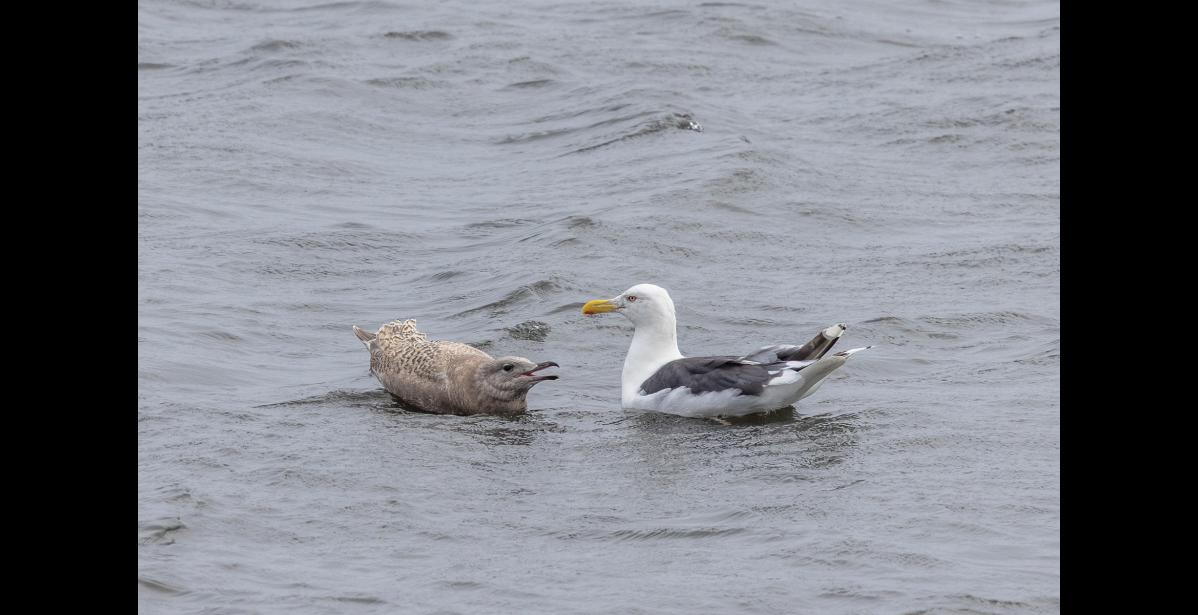
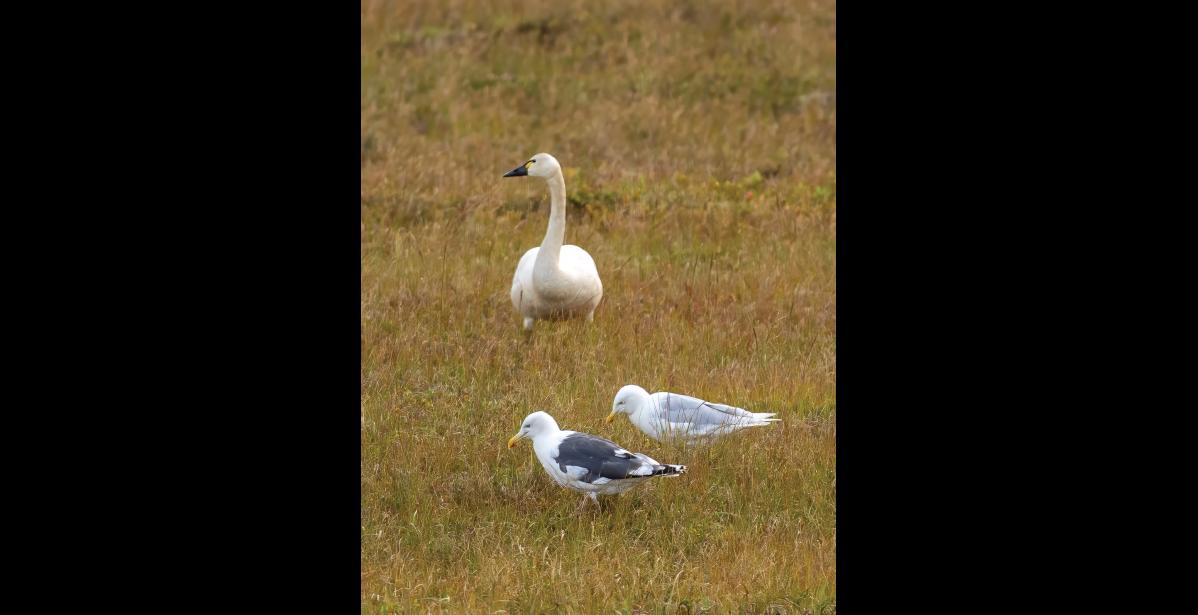
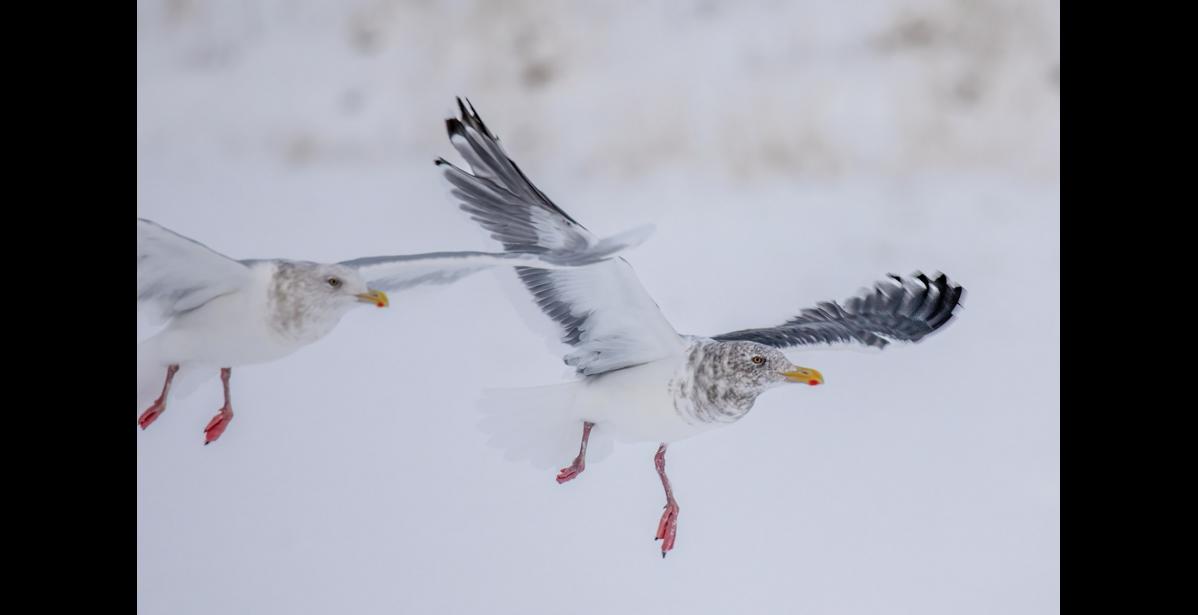
Slaty-backed Gull––a distinctive and uncommon Asian gull makes a surprising appearance with a begging youngster near Nome
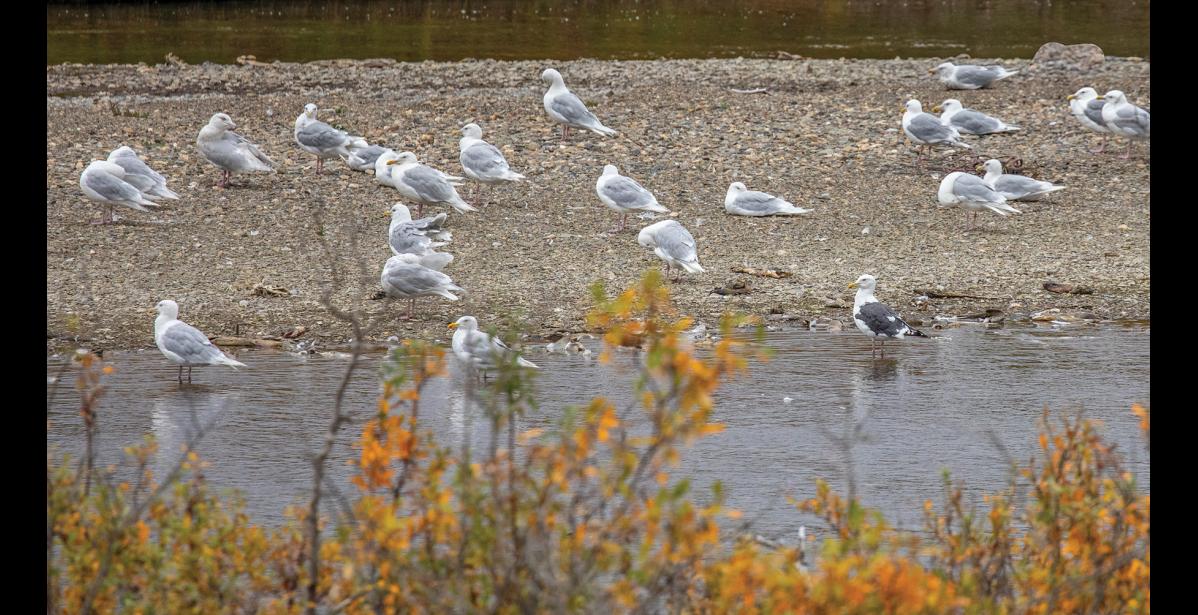
A friend of mine jokingly calls all of our gulls “slaty-backed gulls.” Descriptively, he’s got a point since most of the region’s mature gulls do indeed have gray backs. But the real slaty-backed gull stands way out from the crowd––its back is strikingly darker than that of our other gull species. Slaty-backs are uncommon here, and eye-catching.
The slaty-backed gull is a Beringian species of northeast Asia. Its scientific species name, “schistisagus,” means “slate-colored cloak.”
These large, dark-backed gulls breed mainly along the coast of Russia, south of Cape Navarin in the western Bering Sea. Their breeding range extends south along Kamchatka to the Russia-China border, and a small part of the population breeds in Japan.
The only confirmed observations of slaty-backed gull pairs nesting in North America are on Aniktun Island near Cape Romanzof in the Yukon-Kuskokwim Delta, where a pair nested in 1996 and 1997.
In 2021, a slaty-backed gull mated with a glaucous gull and successfully fledged two chicks at Prudhoe Bay, Alaska. In western Alaska, occasional speculation about hybridization with glaucous-winged gulls occurs but has not been confirmed.
Since slaty-backed gulls are uncommon here, and not known to nest anywhere near Nome, it was a huge and exciting surprise to find an adult slaty-backed gull with an incessantly begging youngster near the Safety Bridge in September. It seemed unlikely that the pair had flown a great distance, and there had been no recent storm to bring them. They had nested nearby.
The plumage of first-year slaty-backs is exceptionally variable, undistinctive and similar to that of our more common, large, white-headed, gray-backed gulls. So it was uncertain whether the young bird was a pure slaty-backed gull, or a hybrid.
I sent photos of the pair to Amar Ayyash, an expert on North American gulls, and asked for his assessment.
Although he could not say with certainty, the pattern on the back of the young gull, and the lighter coloration on its outer wing feathers suggest hybridization with either a glaucous-winged or glaucous gull. Then, gradation of its bill color from dark at the tip to lighter at the base, points to a glaucous gull as the most likely parent. Given that glaucous gulls are by far the most common large gulls breeding here, that assessment makes sense.
Regardless, slaty-backs may be nesting more frequently along Alaska’s vast coastline than is known by western science or reported, whether with their own kind or with close relatives.
Many populations of slaty-backs are nonmigratory, dispersing from their breeding areas into the adjacent Bering Sea or Sea of Japan for winter. Some migrate south towards the coast of China, a few as far south as Taiwan.
Additionally, these Asian gulls increasingly show up as vagrants (birds that stray far outside of the normal range for their species), scattered in far-flung places during their nonbreeding season. They are seen annually along the Pacific coast of North America as far south as central California, in at least 30 states, and in 12 Canadian provinces or territories. A few are spotted almost yearly now in Europe.
The relatively recent vagrancy to Europe has prompted speculation that the reduction in sea ice across the Arctic, which has opened routes between the Pacific and Atlantic Oceans for increasingly longer periods of time, has facilitated this movement.
Slaty-backed gulls commonly winter at the edge of the sea ice in the southern Bering Sea. In spring, some follow the ice edge as it retreats northward, reaching the Bering Strait region in May.
Small numbers of adult and immature migrants and visitors can be seen in spring, and especially in fall along the coasts of the Seward Peninsula, St. Lawrence Island and other Bering Sea Islands.
A very few may remain in summer along the peninsula’s coastline, inlets and estuaries. At least one apparently nested here! In late summer an occasional slaty-back can be seen upriver with other gulls feeding on salmon carcasses.
Where these gulls do breed, they build grass nests on the ground, mainly along the coast atop rocky cliffs or pinnacles, on rocky islands, or on sandy shores amidst low vegetation. Most often they nest in colonies of either their own kind, or with other seabirds.
Like many gulls, the slaty-back is omnivorous and opportunistic when it comes to diet. A variety of fish and invertebrates are their mainstay. Unable to dive deeply, they catch their prey fairly close to the surface after spotting it from air and diving at high speed, headfirst into the water, or by snatching it while surface feeding.
They are always on the lookout for a meal of carrion, bird eggs or chicks, voles, insects or berries. They will glean leftovers from bear-kills, waste from fish and meat processing plants and edibles at landfills. In Asia, flocks gather at fishing ports and processing facilities. In Japan some males specialize in predation at seabird colonies, taking adults and chicks of other nesting birds.
The global population size and trend for the slaty-backed gull is unknown, but there is not believed to be a population concern.
When looking over the flocks of gulls fishing and roosting along our shores this month, keep an eye out for a handsome dark-cloaked gull that pops out of the crowd—that will be a slaty-backed gull (or a hybrid).