
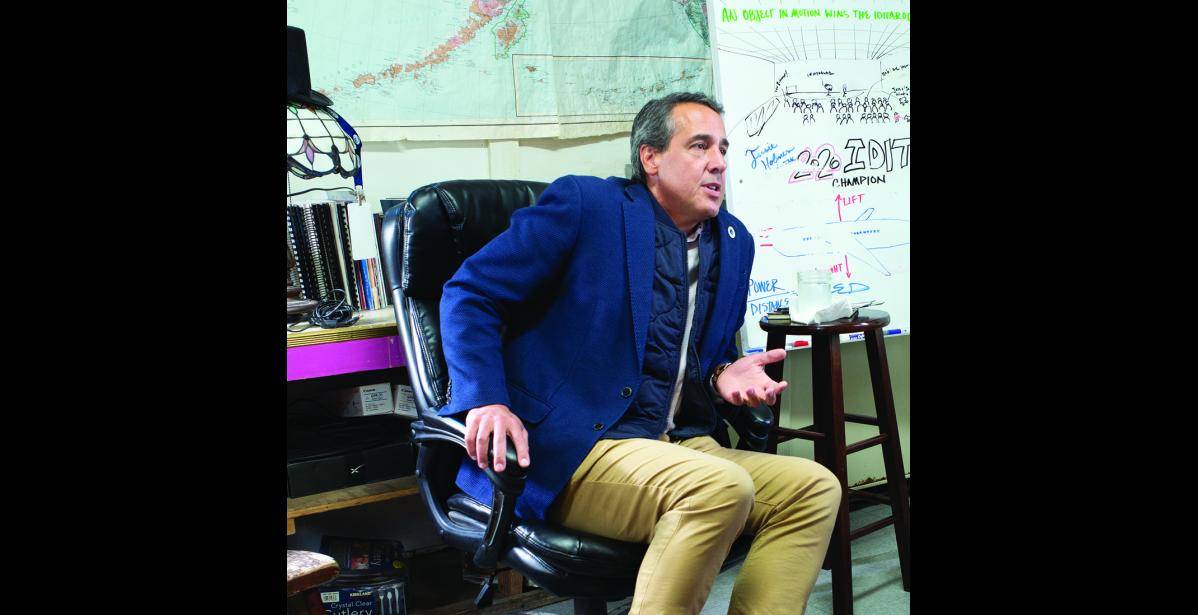
U.S. Arctic Research Commission Chair visits Nome
Fishing was high on the agenda when the newly appointed chairman of the U.S. Arctic Research Commission Tom Dans visited Nome last week.
Dans, excited to have succeeded in fishing for Arctic grayling, and antsy to go to Outfitters to get fishing gear for another trip to fish at the Nome River, visited with The Nome Nugget Friday, August 14 during his two-day trip to Nome.
Asked about the purpose of his visit to Nome, he said he was recently appointed to the chairman position by President Donald Trump in December and he wanted to meet Alaskans to further his understanding of the state and its people. “The key point of the Arctic Research Commission, I guess — and it really is the overall aim of the Trump administration — is to improve the lives of Americans everywhere,” Dans stated. “Now, our specific mission is around the Arctic, and principally we’re looking to help enable better, greater lives, for people to achieve what might be called human flourishing, in wherever they are in the United States. So, it’s very important to come and meet with the people and understand their way of life and understand what’s important to them, and then be able to take that back and help orient the goals and priorities for the research program.”
The overall goal of the USARC under this administration is to “reestablish American leadership in the Arctic and we do that first and foremost through science and research,” he said.
The U.S. Arctic Research Commission, an independent federal agency created in 1984, is tasked to advise the president and Congress on scientific research goals for the Arctic, to develop an integrated national Arctic research policy and to build cooperative links in Arctic research within the federal government, with the State of Alaska and with international partners.
According to the biography posted on the USARC website, Dans “brings 30 years of successful domestic and international investment management and entrepreneurship to USARC, including a wide breadth of private sector resource development experience across the Arctic region.” He has a banking background and worked at large investment funds. Having a degree in Russian studies and having spent a year abroad in Moscow, Russia as an exchange student, Dans later in his career specialized in investments in businesses operating throughout the Russian Arctic and Far East as well as numerous joint U.S./Russian investments. His expertise includes oil and gas, mining, renewable energy, agribusiness and fisheries, telecom, infrastructure and applied technologies, according to the USARC website.
He explained his role as the chairman of the commission: “I work directly for President Trump. I’m not an executive. I’m a volunteer, if you will.”
The commission is comprised of seven political appointees. Dans and another person represent industry. Four are from research backgrounds and speak for the research community, and one Alaskan Native represents the Native community. “We set the overall goals and priorities for the entire Arctic research domain enterprise across the government,” he said. The biggest spenders on Arctic research, he said, include NASA, the Department of Defense, the Dept. of Energy, Dept. of Interior and the National Oceanographic and Atmospheric Administration, or NOAA.
Dans said the priorities for the commission under Trump are topped by national security and military, and economic security. “Our belief is a stronger Arctic means a safer country, and in order to have that, you need a prosperous and growing local population,” he said.
Getting to Nome, Dans experienced the fickleness of traveling in the Arctic due to weather. “In true Nome fashion,” he said, “We were not able to land on day one.” He managed to get into Nome later that day and spent two days here. Asked about the roll-back of weather-related services in western Alaska, he said he was not aware but that he would make an effort to dig in and understand. “Like, I flew in on a full plane and there was nobody in the control tower,” he said incredulously. “And you know this is the United States of America. It’s a full, busy airport, only going to get busier if things are being done right.” (Nome’s airport does not have a control tower). He said with the port expansion coming, there will be some growing pains for Nome. “There are changes coming, and I think it’s incumbent on the government to help get the infrastructure here,” Dans said.
Asked about the suspension of the NOAA Arctic Report Card, Dans said he cannot speak on a policy decision made by NOAA. But, he added, the commission helped start the report. “It is generated mostly by outside researchers, as well as edited, and it’s really a compendium of research where NOAA maybe helps fund the piece. But that is not to say that it couldn’t exist under a different sponsorship. So I really can’t talk to the future of it,” he said. Asked if he sees value in the report, Dans said, he hesitates to comment. “That would be a little bit outside of my lane,” he said.
This visit, he said, is hopefully the first of many visits. “It’s more focused on making relationships, meeting people, and listening at this point,” Dans said.
In Nome, Dans said, he visited with NSEDC, city officials including Nome Mayor Kenny Hughes, went on a tour of the Port of Nome, met with the UAF Alaska Sea Grant Marine Advisory program, Kawerak, Graphite One and locals who took him fishing.
He also visited the NOAA hydrographic survey ship Fairweather, while it was docked in Nome.
In all, he is spending a month in Alaska, visiting Utqiagvik, Anchorage, Fairbanks, Kaktovik and maybe Kotzebue on the itinerary. He already had been to Kodiak, Homer, Seward, and visiting with U.S. Coast Guard and NOAA facilities in Alaska.
Editor's note: The story is updated from an earlier version, to reflect that Dans also received a tour of the Port of Nome and met with the UAF Alaska Sea Grant Marine Advisory program.