
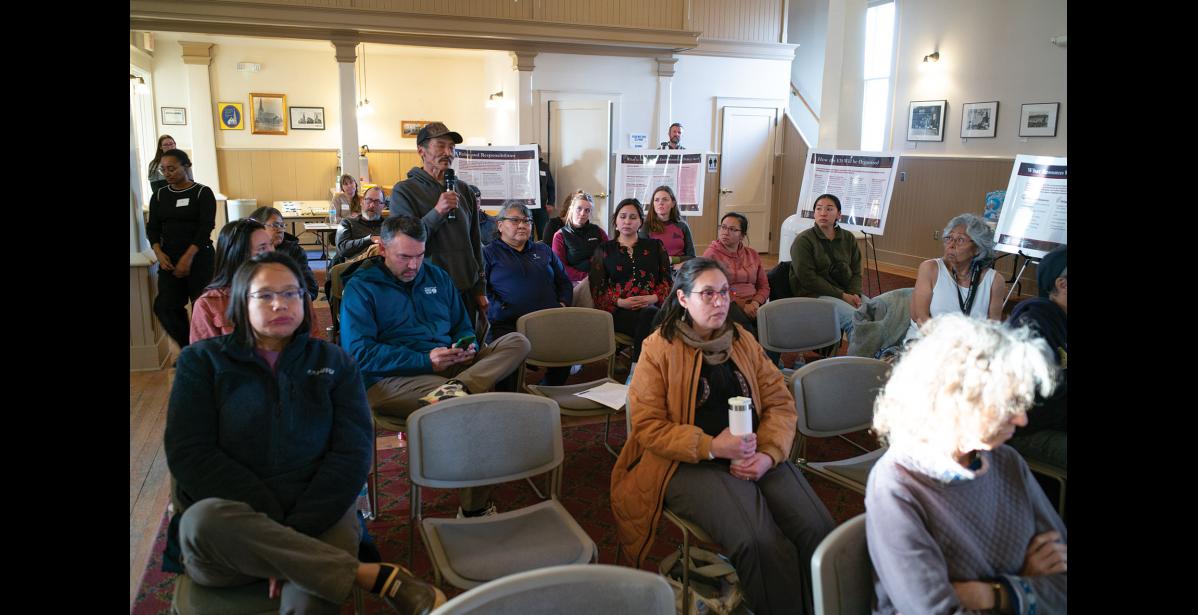
Graphite One: US Army Corps takes public input as Environmental Impact Statement is prepared
The federal agency charged with permitting major developments that affect the waters of the United States is taking public comment on the proposed graphite mine development, about 70 miles north of Nome and a shorter distance east from the villages of Teller and Brevig Mission.
The Alaska District of the U.S. Corps of Engineers convened a so-called scoping meeting in Nome last week to introduce the process of an Environmental Impact Statement that is being prepared prior to a decision made whether, or in what form the graphite mine would be permitted. The process is governed by the National Environmental Policy Act, or NEPA, “for actions that significantly affect the quality of the human environment.”
Project Manager Greg Mazer with the Alaska District of the Corps explained that the Regulatory Division of the Corps is responsible to respond to the Graphite One LLC permit application for discharging fill into waters of the U.S. in association with the proposed mine. In all, 387 acres of wetlands would be permanently destroyed and 140.7 would be temporarily impacted. The federal laws under which the project is regulated are the Clean Water Act and the National Environmental Policy Act, also known as NEPA. In addition to federal permits, the mine would need several permits from the State of Alaska.
Graphite One has for at least a decade conducted baseline studies, core drilling and received federal funds to finish a feasibility study to pursue the building of the graphite mine in earnest. Initially, the Corps conducted a less comprehensive analysis of the impacts the mine will have under an Environmental Assessment. This changed last August. “We determined that because of the considerable potential for significant impacts to occur to the environment, we had to step it up to the EIS level, an environmental impact statement.” Mazer said. “In this scoping meeting, we’re informing the public about the proposal and soliciting feedback in the form of comments that will help guide us with our analysis that we’re compelled to do for the EIS, and that will help us also to determine if there are some feasible or reasonable alternatives to what’s been proposed.”
Graphite One proposes to build a graphite mine and industrial mill complex on the northern slopes of the Kigluaik Mountain range, near Imuruk Basin. To reach the remote and rugged location, Graphite One proposes to use a gravel road from Nome to mile 30 and then build a 17.3-mile-long gravel haul road through Mosquito Pass to reach the mine site. The miners propose to haul the graphite ore on container trucks to the Port of Nome year-round, as well as daily bussing employees to the mine and delivering fuel and other supplies to the mine.
Also present were Graphite One representatives, who supplied a short video with an overview of the proposal, including 3D renderings of the pit, the mill complex and the tailings facility.
Mazer, an environmental scientist by training, explained the Corps’ charge to review projects that propose to fill materials into water. “We are guided by this mission to protect the nation’s aquatic resources and navigable capacity, while allowing reasonable development through fair, flexible, and balanced permit decisions. So, we’re trying to balance the need for development and the need to protect aquatic resources,” he said.
The outcome of the EIS is a comprehensive document that describes the purpose and need for the proposed project, as well as reasonable alternatives. Throughout the EIS process, he said, “we are soliciting input from the public as well as from government agencies and stakeholders.”
The review is guided by criteria that balance destruction and need for the resource. “There can’t be any significant degradation to waters in the U.S. and there can’t be any violation of other laws such as NEPA or the Endangered Species Act or a number of other laws that we need to need to abide by,” said Mazer. “We also have to conduct a public interest review, that’s we are weighing the benefit, overall benefits, and overall detriments of a particular project to the public.” The public, he explained, are those living in the vicinity of the project, living in the region as well as the entire nation.
He added that prior to the public meeting that day, the Corps was engaging in formal tribal consultations. “We had representatives from the tribal council of Mary’s Igloo, Teller and Brevig Mission, although we didn’t get nearly as many folks from Brevig Mission as we had really hoped for, because it was it was too stormy for them to cross the channel this morning,” he said. Most concerns voiced were worries about the effects of the mine on subsistence, water quality, fish, wildlife and the way of life and culture.
How to effectively comment
Mazer invited the audience to comment. The regulators had comment sheets at the ready and recording devices for those who wanted to submit their comments by voice. People took advantage of that and were seen speaking into the recorders.
Comments need to be received by November 2. But not all comments are equally weighed. Mazer said substantive comments have a much greater impact than non-substantive comments. A substantive comment, he said, is “coming from a documented set of evidence and it has to be based on certain information that can be proven to be true.”
He said be specific about a potential impact that could be caused rather than just issuing broad statement of opposition to the mine. So, the more specific, the better. The more data or information that you can cite, the better that that comment will be,” Mazer said.
Timeline
Since the project is part of an accelerated FAST-41 trajectory, the final EIS would be completed September 10, 2027, with a decision made on Sept. 24, 2027. “We hope to issue a draft environmental impact statement at some point in the spring, but we have not yet committed to that,” Mazer said. “But we certainly have committed to issuing the final EIS in September, and the record of decision a couple weeks later.”
Nome resident Austin Ahmasuk asked a pointed question why is there no draft EIS that the public can comment on before an EIS is published and quickly followed up with an agency decision. “I was pretty disappointed when you said that you hoped to issue a draft EIS,” Ahmasuk said. He’s convinced that NEPA requires a draft EIS. Mazer responded that since the Corps pivoted from the EA to the EIS a year into the EA process, they have a lot of information already, but they are on an accelerated timeline. “Normally agencies have two years to complete the EIS process from start to finish, and the start being the date that the notice of intent is issued. Instead, we really only have about one year’s time to get this done,” he said. Ahmasuk said that just because they’re on short on time, the agency cannot ignore NEPA rules. Right, said Mazer, but the rules have changed and no longer require a draft EIS being presented to the public. This change was not reflected in the Corps’ website outlining the EIS process, which still states that a draft EIS needs to be prepared and is then out for a 45-day public comment period.
Jerry Okbaok with the Native Village of Teller introduced himself as one of the many hunters and fishermen who use the area that will be impacted. The hunters catch fish and harvest seals for subsistence food. He asked what about the seals? He asked about the ringed, spotted and bearded seals that use the Imuruk Basin as a nursery and then migrate to Grantley Harbor and Port Clarence. “In the springtime, you see thousands out there. They’re all being born at the nursery, most of them take off but we get a large population that stays in that Imuruk Basin.” They are there year-round, he said. And, he said, we eat the animals that are harvested from the creeks and the riverbanks along Imuruk Basin. Okbaok was concerned about contamination that industrial development brings. Will it be safe to eat them when that project goes forward? Mazer answered that the Corps has consulted with the National Marine Fisheries Service regarding the possible and anticipated impacts to endangered species. “The bearded seal and the ringed seal and their critical habitat was considered in that analysis, and the National Marine Fisheries Service concurred with us that our determination was that the project may affect but is not likely to adversely affect those species as well as other species that are listed under the Endangered Species Act,” Mazer said.
As people mingled and asked questions in front of informational poster boards displayed, Johnny Topkok took out his cell phone and showed photos of rock formations that are in fact ancient blinds used by hunters waiting for caribou. Right there, he said, are these cultural sites, where the proposed road would go through Mosquito Pass.
The Army Corps plans a virtual scoping meeting on Monday, Oct. 26. For more information go to www.graphitecreekEIS.com