
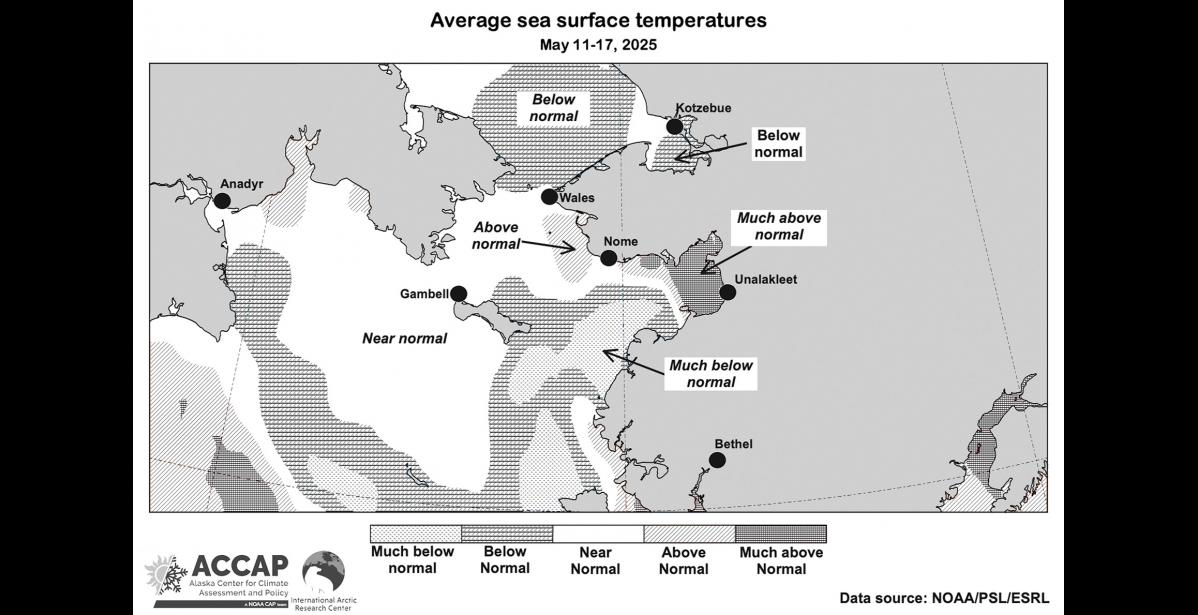
Sea Surface Water temperatures vary

By Rick Thoman
Alaska Climate Specialist
Alaska Center for Climate Assessment and Policy
International Arctic Research Center/University of Alaska Fairbanks
Sea ice is rapidly melting in the Bering Sea, and as the ice melts it leaves cold water at the surface. So it’s not unusual this time of year for sea surface temperatures to vary widely over short distances, even after accounting for the normal variations.
This spring, eastern Norton Sound has been largely ice-free since the last week of April, as has the area west of Woolley Lagoon northeast to offshore Wales (though not quite as consistently as eastern Norton Sound). As a result, the ocean surface in those areas have had several weeks now to be warmed by the increasing solar heating.
In contrast, areas where ice has persisted, the water temperature remains close to freezing, which may be cooler than average since the late persisting ice isn’t in the places same every spring.
The result is the patchwork seen in the graphic, showing the temperatures relative to the 1991-2020 normal for the week ending May 17. Because high concentration ice has persisted into mid-May offshore of the Yukon Delta coast, sea surface temperatures are well below normal, while east of Stuart Island ocean temperatures are much above normal.
In contrast, most of the Bering Sea between St. Lawrence and St. Matthew Island has near normal sea surface temperatures. From Little Diomede northward, sea ice has remained extensive, which has not been the case in some recent years, so ocean water temperatures are a bit below normal.
